Guides
How to Inspect a Ring for Loose Stones at Home (3-Minute Check)

The scariest words in fine jewelry are, "Wait—was that stone always tilted?" A loose stone doesn't announce itself. It starts with a tiny prong that has bent a fraction, then catches on a sweater, then one morning the ring looks empty. You can prevent this. Once a month, give your engagement ring or favorite ring a three-minute at-home inspection. It takes no tools and catches almost every problem early.
Why stones loosen in the first place
Rings are worn every day, and prongs take a beating. Hand lotion, soap, and sweat don't hurt the metal, but opening cans, typing, gripping a steering wheel, and knocking the ring against hard surfaces put pressure on the prongs over months. A prong that was tight on day one can thin out or bend after a year of normal wear. Colored stones, side stones, and pavé diamonds are even more prone to loosening than a central solitaire, because their prongs are smaller.
The 3-minute home inspection
Do this once a month. Pick a quiet room with good light, and set a timer if it helps.
Step 1: The rattle test (30 seconds)
Hold the ring up to your ear and shake it gently next to your ear. A loose stone will make a tiny, faint rattle—like a grain of rice inside a pillbox. It is subtle, so do it in a quiet room. If you hear anything, stop. The stone is loose and needs a jeweler immediately. Do not wear the ring until it's fixed.
Step 2: The prong visual (60 seconds)
Put on reading glasses if you need them. Look at each prong holding the main stone. Healthy prongs stand straight, taper smoothly to the tip, and end in a small rounded bead that sits on top of the stone. What you're looking for:
- A prong that looks bent or tilted.
- A prong that looks thin or worn—like a wire that has been sanded down.
- A prong tip that is missing or flattened against the stone.
- A stone that sits at a slight angle compared to the band.
Run a finger gently over the top of each prong. If you feel a rough edge or a hook that catches on your skin, that prong is worn and needs attention.
Step 3: The toothbrush test (60 seconds)
Dirt and soap buildup hide loose prongs. Use a soft baby toothbrush with warm soapy water and scrub around the setting, especially under the basket. Rinse and dry. Now look again. Clean prongs show their true condition, and you'll notice a bent or worn tip that soap was hiding.
Step 4: The tug test (30 seconds, very gentle)
Use a pair of tweezers or a wooden toothpick (never metal) and very gently nudge the stone from side to side. A securely set stone should not move at all. If it shifts even slightly, the prongs are weak. This is a diagnostic test, not a force—you're feeling for movement, not trying to move the stone.
Side stones and pavé: check them too
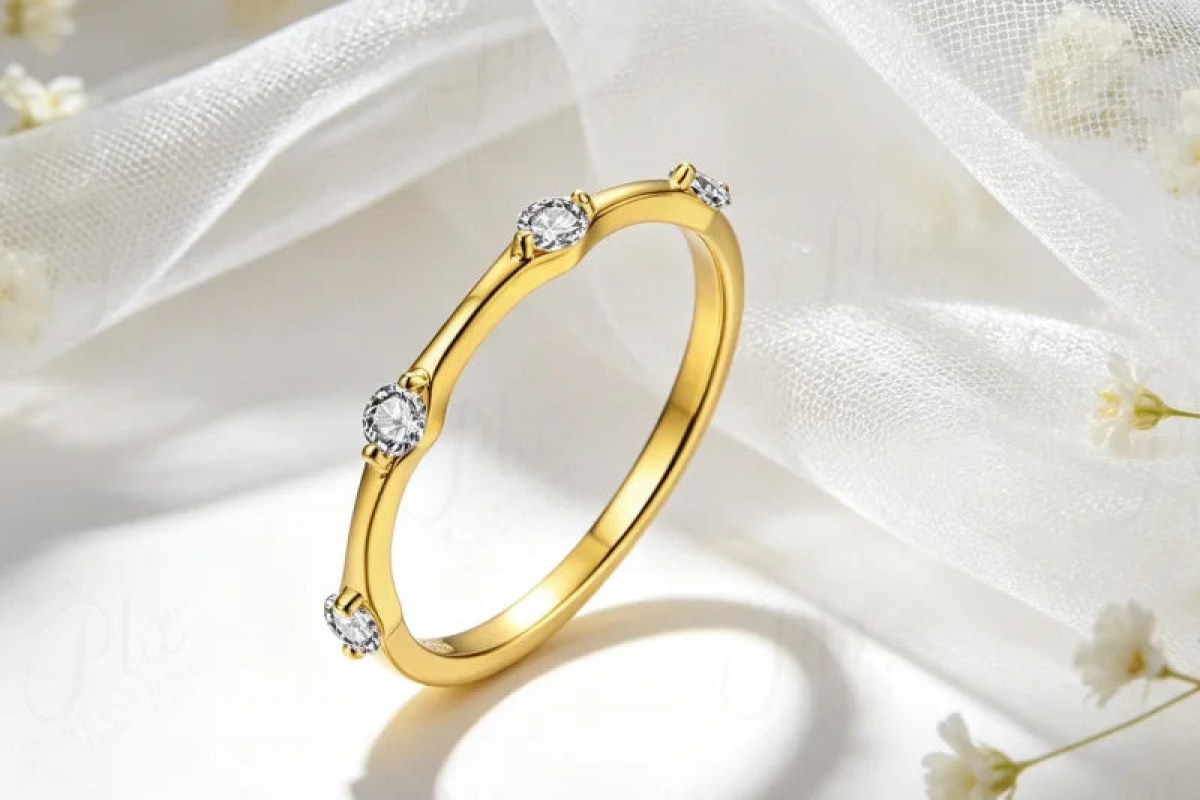
The center stone gets all the attention, but side stones and pavé diamonds or moissanites are even more fragile. Their prongs are tiny. Run a fingernail lightly along each row of small stones. If your nail catches on a stone that sticks up a little, that stone is lifting. Get it to a jeweler within a week.
What to do when you find a problem
If the rattle test makes noise, or the stone moves under your gentle tug, stop wearing the ring. Wrap it in a soft cloth and take it to a jeweler. Don't wait until your next anniversary. A re-tip or prong tightening usually costs $20 to $60. Replacing a lost stone costs hundreds, and losing an irreplaceable heirloom stone is worse.
If you see only a slight roughness on a prong tip but the stone is tight, put the ring on your calendar for a jeweler visit in the next month. It's not urgent, but it shouldn't wait six months.
How often to inspect professionally
Even if your home check looks perfect, a jeweler should look at the ring once or twice a year. They have tools that can see under prongs and test tension in ways you can't at home. Many jewelers do this inspection for free, and some will clean the ring for you at the same time.
Prong types and which ones fail first
Not all prongs are created equal. Six-prong settings (like a classic Tiffany-style solitaire) are the most secure because each prong takes less pressure. Four-prong settings show more of the stone but put more force on each prong, so they wear faster. Prong settings with tiny "bead" prongs (common on pavé) are the most fragile—a single bead can snap after a year of catching on sweaters. Bezel settings, where the stone is wrapped in metal, almost never loosen on their own, but the metal can thin and open over decades. If you know your setting type, you know where to look first when you do your monthly check. Pavé rows need the closest inspection; bezels need the least.
Lifestyle tips that reduce loosening
- Take the ring off before the gym, gardening, or any heavy gripping.
- Don't open cans or bottles with the ring hand.
- Apply lotion and perfume before you put the ring on, not after—lotion seeps under prongs and weakens the solder over years.
- Store rings separately so they don't knock against each other (see our ring storage guide).
Moissanite-specific notes
If your stone is moissanite, the inspection process is the same as for diamond, but there is one difference to know. Moissanite is slightly less brittle than diamond, but it is also doubly refractive, which means you may see subtle internal lines through a loupe. Those internal lines are normal and not a sign of damage. What is a sign of damage? A chip on the edge of the stone, or a stone that suddenly looks "cloudy" where it used to look clear. Moissanite rarely chips, but a hard knock against a tile or concrete can do it. If you ever drop your ring on a hard floor, give it the full three-minute inspection when you pick it up, even if it looks fine.
The bottom line
A loose stone is a slow problem, and the home check takes three minutes. Shake the ring to your ear, inspect each prong under good light, clean the setting, and give the stone a gentle nudge. Do this once a month, and you'll catch loose prongs long before a stone falls out. Pair it with a yearly professional inspection, and your ring will stay secure for decades.
Related Posts
Written By
Jewelry Forum Hub Team
Gemologists and setters at our own workshop. We have been cutting moissanite and lab grown stones since 2013.