Buying Guides
How to Choose an Engagement Ring Under $1000

A $1,000 engagement ring budget sounds tight if you have been walking into traditional jewelry stores. In a mall shop, that figure might buy you a tiny mined diamond in a thin gold band. Shop online with the right stone choice, and $1,000 buys a ring that looks far more expensive. The secret is knowing where to spend and where to save. This guide shows you how to get the most stunning ring possible for under a thousand dollars.
What $1,000 actually buys
First, set expectations. With a natural mined diamond, $1,000 usually gets you a stone under 0.30 carats in a modest setting. With a lab-grown diamond, the same budget stretches to roughly 0.70 to 1.0 carat depending on the grade. With moissanite, $1,000 can buy a well-cut 1.5 to 2 carat equivalent center stone in a solid 14k gold setting, often with accent stones.
The lesson: stone type changes everything. Your budget is not the limit; the material you choose is.
Option 1: Moissanite for maximum sparkle per dollar
If size and brilliance matter most, moissanite is the value king. Moissanite is optically very close to a diamond, often even more brilliant, and it costs a fraction of the price. For under $1,000 you can get:
- A 1.5 to 2 carat equivalent moissanite center stone.
- A 14k gold or sterling-silver-over-gold setting.
- A solitaire, halo, or three-stone style.
The tradeoffs: moissanite has slightly higher sparkle dispersion (more rainbow fire), and it is less dense than a diamond, so it feels lighter on the finger. Some people also care about resale value, which is low for both moissanite and lab-grown stones. But for everyday beauty at this price, it is hard to beat.
Option 2: A small lab-grown diamond for diamond purity
If your partner specifically wants a real diamond, go lab-grown. A 0.70 to 1.0 carat lab-grown diamond in a good cut, a near-colorless grade, and a clean clarity can fit within $1,000 once you budget carefully for the setting. Prioritize cut above all else: a well-cut smaller diamond looks brighter than a poorly cut larger one. Choose a simple solitaire setting to keep costs down, and let the stone be the star.
Where to spend the money
On a tight budget, every dollar should pull its weight. Spend on what is visible and structural.
The center stone and its cut
This is the heart of the ring. With moissanite, choose a reputable brand and a near-colorless grade. With lab-grown, prioritize cut, then color, then clarity.
The band metal
A solid 14k gold band will last decades. Avoid plated or filled metals that wear away in a year or two. If even 14k gold is out of reach, quality sterling silver is a reasonable starter that can be upgraded later.
Craftsmanship and prongs
Look for smooth prongs that fully cover the stone's edges. Thin, wobbly prongs mean the stone is at risk. Read reviews about build quality.
Where to save without looking cheap
- Skip unnecessary side stones. Pavé and halos add cost; a clean solitaire looks classic and lets the center stone shine.
- Choose a slightly lower color grade. Near-colorless grades look white in a setting and cost less than top grades.
- Avoid premium retail markup. Online direct-to-consumer sellers cut out the middleman. A ring sold online for $800 might carry a $2,500 tag in a mall store.
- Buy the setting and stone from one seller. Separate purchases mean extra setup fees that eat your budget.
Setting styles that stretch a small budget
Certain settings make a modest stone look larger and more luxurious.
- Halo setting: A ring of small accent stones makes the center stone look dramatically bigger. In moissanite, the accent stones are cheap, so this is high impact for low cost.
- Cathedral or raised prongs: Lifting the stone lets light pass under it and makes the ring feel airy and premium.
- Thinner band: A 1.5 to 2mm band makes the center stone look larger by comparison.
- Pavé shoulders: A few tiny stones on the band add sparkle without a big price jump.
Red flags when shopping under $1000
Low price is great, but an unrealistically low price is a warning. Watch for:
- No certification or certificate from an unknown lab.
- "Diamond" claims at prices that are physically impossible for a real stone.
- Plated-over-base-metal bands advertised as solid gold.
- No return policy or a return window shorter than 14 days.
- Stock photos only, with no real customer review photos.
A sample $950 build
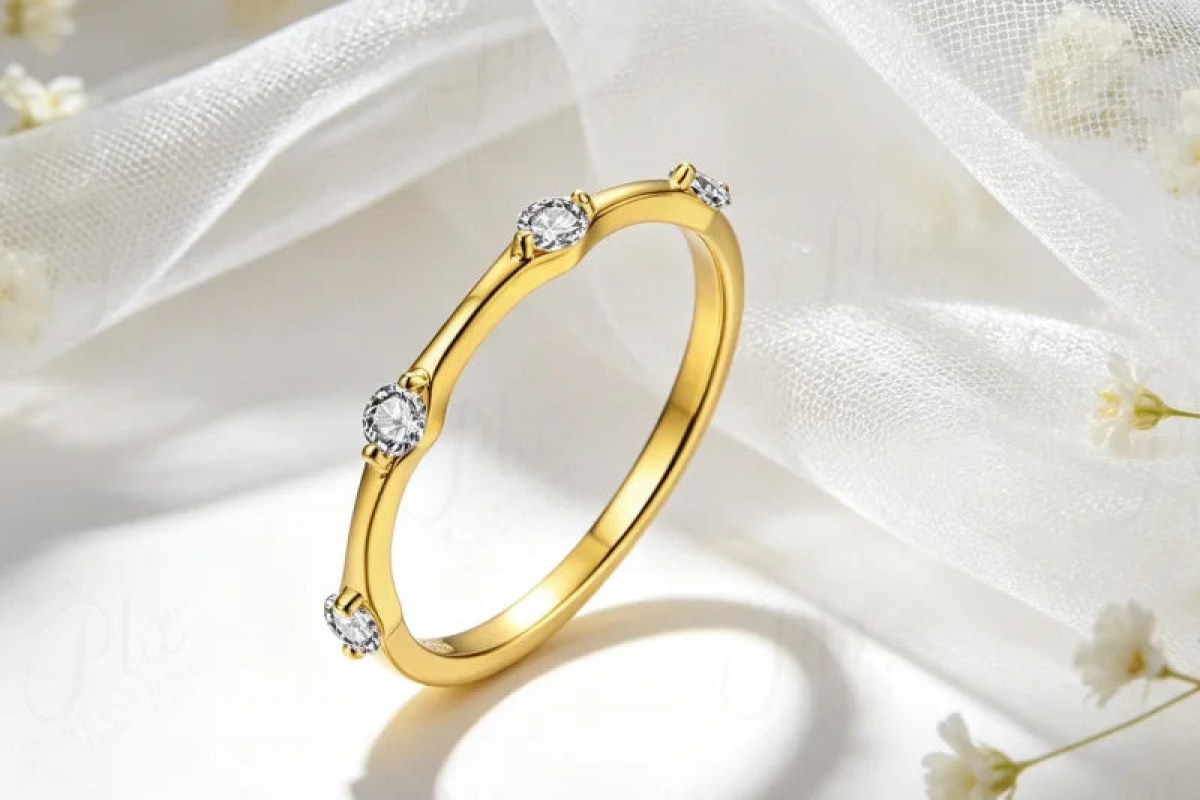
To make this concrete, here is a realistic under-$1,000 build: a 1.5 carat equivalent near-colorless moissanite in a slim 14k white gold halo setting, sized by a certified seller, with a 30-day return window and a lifetime warranty. That ring photographs beautifully, wears comfortably, and looks like a several-thousand-dollar piece. The same budget on a mined diamond would buy a stone most people would need a magnifier to admire.
Does a cheap ring mean it looks cheap?
This is the fear most people have on a tight budget: that spending less means a ring that looks plasticky or flimsy. Done right, it does not. The rings that look cheap are the ones that cut corners on the visible things: plated bands that wear to brass, cloudy stones that lack fire, and thin prongs that wobble. A ring that spends its budget on a well-cut certified stone and a solid 14k gold band reads as expensive, because the material underneath is real. The difference between a $500 ring that looks like $500 and one that looks like $2,000 is almost entirely where the money was allocated, not how much was spent.
When you are on a budget, be ruthless about the tradeoffs. Choose one center stone that is genuinely nice, set it in a solid but simple band, and skip everything decorative. That single-mindedness is what lets a small budget look like a generous one.
One last tip: build a little breathing room into your budget. Aim to spend around $900 rather than the full $1,000, so you have room for tax, insured shipping, or a resize without blowing past your limit. A ring you can comfortably afford beats a ring that maxes out the card.
The bottom line
An engagement ring under $1,000 is completely achievable and can look stunning, as long as you are smart about material choice. Go moissanite for maximum size and sparkle, or a smaller well-cut lab-grown diamond if "real diamond" matters. Spend on the stone and a solid gold band, save on fancy accents and retail markup, and only buy from a certified seller with a generous return policy. Your budget is a constraint on the details, not on how beautiful the ring can be.
Related Posts
Written By
Jewelry Forum Hub Team
Gemologists and setters at our own workshop. We have been cutting moissanite and lab grown stones since 2013.