HOLYCOME EditorialOP
November 18, 2026 · 6 min read
Earrings Wholesale: Landed Cost Math for Your First Order
9 replies in this thread
Why the Invoice Price Is Not Your Real Cost
Every week a buyer sends me a screenshot of a quotation and asks whether it is a good deal. Nine times out of ten they are comparing the wrong number. The unit price on that sheet is where the conversation starts, not where your money ends. Earrings wholesale pricing has at least five more layers stacked on top of it before the goods sit in your warehouse.
I have spent twelve years on the QC bench and in the shipping bay, and I have watched first-time buyers get burned by freight they forgot to quote and stone rejects they did not budget for. So let us walk through a realistic first order, number by number, the way I would explain it to a new buyer standing next to my inspection table.
The Five Cost Layers in Any Earrings Wholesale Order
Think of your landed cost as a stack. Each layer adds to the one below it, and skipping a layer is how people end up selling at a loss without understanding why.
- Ex-works unit price: what the factory charges per pair before anything moves.
- Packaging and labeling: pouches, backing cards, barcode stickers, poly bags.
- Freight: air express, air cargo, or sea, plus insurance if you want it.
- Duty and import VAT: depends on your country and the declared HS code.
- Quality loss allowance: the pairs that fail inspection or arrive damaged.
Most buyers only model the first layer. That is the mistake. The other four are where a 30 percent margin quietly turns into a 4 percent margin.
A Worked Example: 300 Pairs of 925 Silver Studs
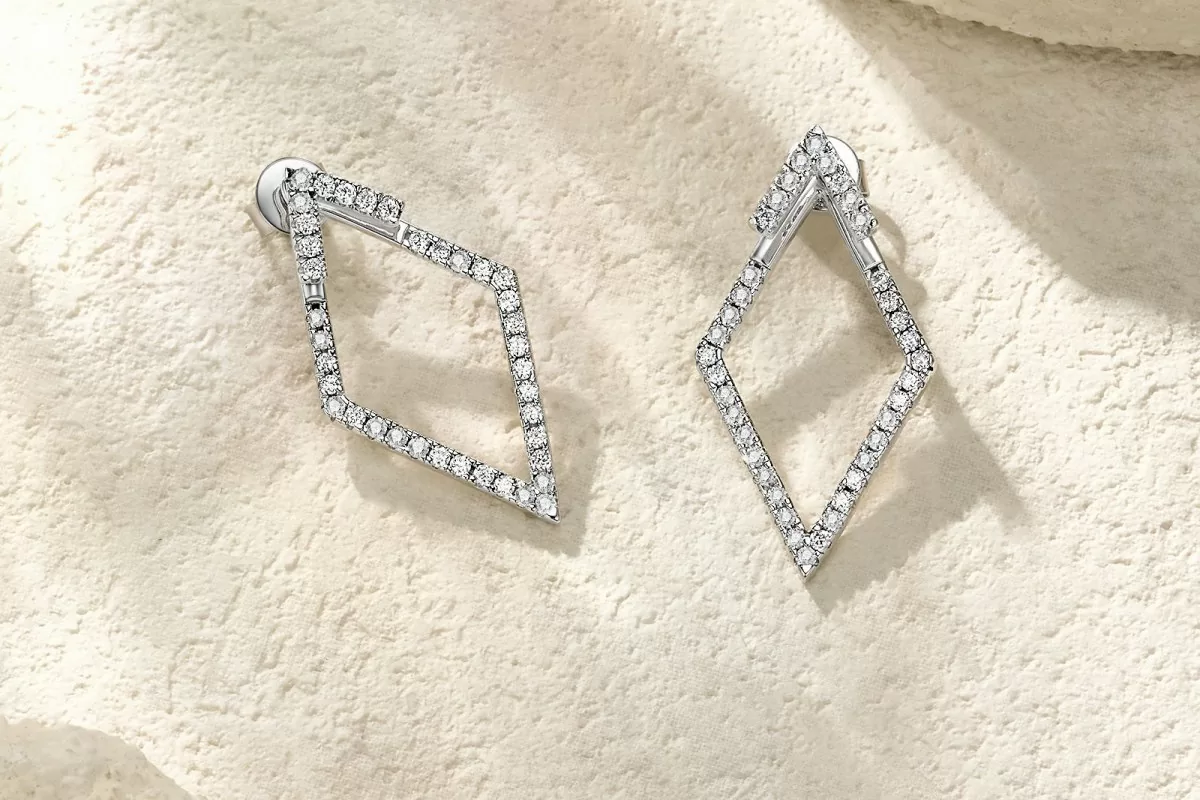
Let us use a concrete order. Three hundred pairs of 925 sterling silver studs with 5mm moissanite, three styles, 100 pairs each. This is a typical first order because it clears most custom minimums without tying up too much cash.
Ex-works price lands around 6.80 USD per pair for this spec at 300 pieces. That is 2,040 USD for the goods. Packaging with a branded pouch and printed backing card adds roughly 0.22 USD per pair, so 66 USD. Now the goods value is 2,106 USD.
Air express DDP for about 14 kg to a US address runs 5 to 8 days and typically quotes near 260 USD for this weight band. Duty on silver jewelry into the US is low, but the merchandise processing fee and any state-level charges still apply, so budget 40 to 90 USD. Add a quality allowance: assume 2 percent of pairs fail pre-ship inspection and get replaced or credited, which is about 42 USD of value at risk.
Total outlay: roughly 2,450 to 2,500 USD for 300 pairs, or about 8.20 to 8.35 USD landed per pair. That is a 20 to 23 percent markup over the ex-works number before you have sold a single pair. If your retail plan assumed 6.80, you just lost your margin on paper.
Landed Cost Breakdown Table
| Cost line | Basis | Amount (USD) | Per pair (USD) |
|---|---|---|---|
| Goods, ex-works | 300 pairs x 6.80 | 2,040 | 6.80 |
| Packaging and labels | 300 x 0.22 | 66 | 0.22 |
| Air express DDP | 14 kg, 5-8 days | 260 | 0.87 |
| Duty and fees | Estimate | 75 | 0.25 |
| Quality allowance | 2% of pairs | 42 | 0.14 |
| Total landed | Sum | 2,483 | 8.28 |
Notice how the freight and duty together add more than a dollar per pair on a small order. On 3,000 pairs the same freight spreads across ten times the units and drops to maybe 0.15 USD per pair. This is the single biggest reason first orders feel expensive. Volume is not just about unit price; it is about diluting fixed costs.
Where the Factory Side Actually Saves You Money
Here is a number I can defend from the floor. Our cost, speed, and yield run about 20 percent better than typical trading companies on the same spec. The reason is not magic. We cut and set stones in-house, so there is no middleman markup on the stone line, and we inspect before shipping rather than discovering problems at your door.
That 20 percent shows up in three places. First, the ex-works price is closer to raw material plus labor because nobody is adding a sourcing fee. Second, production runs 12 to 18 days for custom work instead of the 30-plus days a trading desk often quotes while they wait on a subcontractor. Third, our pre-ship AQL inspection catches defects before freight, so your quality allowance line shrinks instead of growing.
On a first order, the cheapest quotation is rarely the lowest landed cost. The factory that ships clean, on time, and without a stone swap is the one that protects your margin.
MOQ, Certificates, and Payment Terms That Affect Cash Flow
Cash flow is part of landed cost. Money tied up in a slow deposit cycle is money you cannot spend on ads or inventory. Here is how the terms usually break down for earrings wholesale.
- Stock designs: MOQ 1 piece, so you can sample before committing.
- Custom designs: MOQ 30 pieces per style, which is low for a factory and realistic for a test launch.
- Production time: 12 to 18 days after deposit and artwork approval.
- Certificates: GRA for moissanite, IGI available for lab-grown diamond where the spec calls for it.
- Payment: T/T 30 percent deposit with balance before shipment; PayPal accepted for sample orders.
- Delivery: DDP, typically 5 to 8 days door to door.
Three-stage QC is standard: incoming stone check when material arrives, in-process inspection during setting and polishing, and a pre-ship AQL pass before cartons close. Ask any supplier to describe their stages. If the answer is vague, that is your answer.
How to Build Your Own Landed Cost Sheet
Do not trust a supplier's landed cost estimate. Build your own sheet with these columns: ex-works price, packaging, freight quote, duty rate, quality allowance, and total per pair. Then add your target retail or wholesale price and see what margin survives.
A simple rule I give buyers: if landed cost is more than 40 percent of your planned selling price, the order is too small or the spec is too rich. Either raise the quantity to spread freight or simplify the design to cut the stone line. Both are easier than renegotiating after the deposit is gone.
Also confirm the HS code and duty rate for your destination before you approve the order. Earrings classified as silver jewelry and earrings classified as imitation jewelry can carry very different rates, and the difference on a 2,000 USD order is real money.
Frequently Asked Questions
What is the minimum order for earrings wholesale?
Stock designs start at 1 piece so you can order samples. Custom designs require 30 pieces per style, and production takes 12 to 18 days after deposit and artwork approval.
How is the price calculated per pair?
Price is quoted ex-works per pair and depends on metal weight, stone grade, and setting labor. Freight, duty, packaging, and quality allowance are added separately to reach your landed cost.
What certificates come with the order?
Moissanite ships with GRA certificates, and IGI certificates are available for lab-grown diamond specs. Ask for the certificate body in writing on the quotation so there is no substitution later.
Get a Real Landed Cost Quote
Send me your earring spec, target quantity, and destination zip code, and I will send back a line-by-line quote with freight and duty estimated, not hidden. Message WhatsApp +86 133 7744 7107 or email service@holycome.com for samples or a first-order quotation, and ask for the QC report format so you know exactly what you are buying.
Join the thread. Ask a sizing, setting or sourcing question and the bench answers.
Post a questionWritten By
HOLYCOME Editorial
Gemologists and setters at our own workshop. We have been cutting moissanite and lab grown stones since 2013.